Skylight Replacement in Passaic from $500. $500 to $1,500 for most units, and the curb is what actually leaks. Free inspection and a written quote.
Skylights on a flat roof behind a parapet are a different job from skylights on a pitch. The unit sits on a curb rising out of a membrane, and the membrane has to be dressed up and over that curb properly -- which is where almost every flat-roof skylight leak actually comes from.
A skylight replacement is $500 to $1,500 for most units and $3,000 or more where the opening or the structure has to change. A New Jersey permit is typically $100 to $350. And if you have more than one to do, doing them together saves 10 to 20 per cent per unit, because the crew is already set up on the roof.


A skylight replacement is $500 to $1,500 for most units, and $3,000 or more where the opening or the structure changes. A New Jersey permit is typically $100 to $350. If you have more than one, doing them together saves 10 to 20 per cent per unit because the crew is already set up on the roof. Here the roof has no eaves and no gutter: it drains through a parapet outlet, so the work is edge work and the outlet is the whole drainage system. Access is the other factor -- no side yard, and a dumpster that needs a street arrangement.
Almost every skylight leak is a flashing leak rather than a glass or seal failure. The unit sits on a curb and the covering has to be dressed up and over it. Sealing round the outside is a lid on the problem for a season.
A fogged, failed unit needs replacing. A sound unit on a bad curb does not, and we will say so. Where the unit is being replaced anyway, that is the moment to put a proper manufacturer flashing kit in while the covering is open.
Enlarging an opening, which is framing work. A steep pitch needing staging. Rot in the curb, found once the unit is out. And a flat roof, where the membrane has to be dressed to the curb rather than lapped around it.
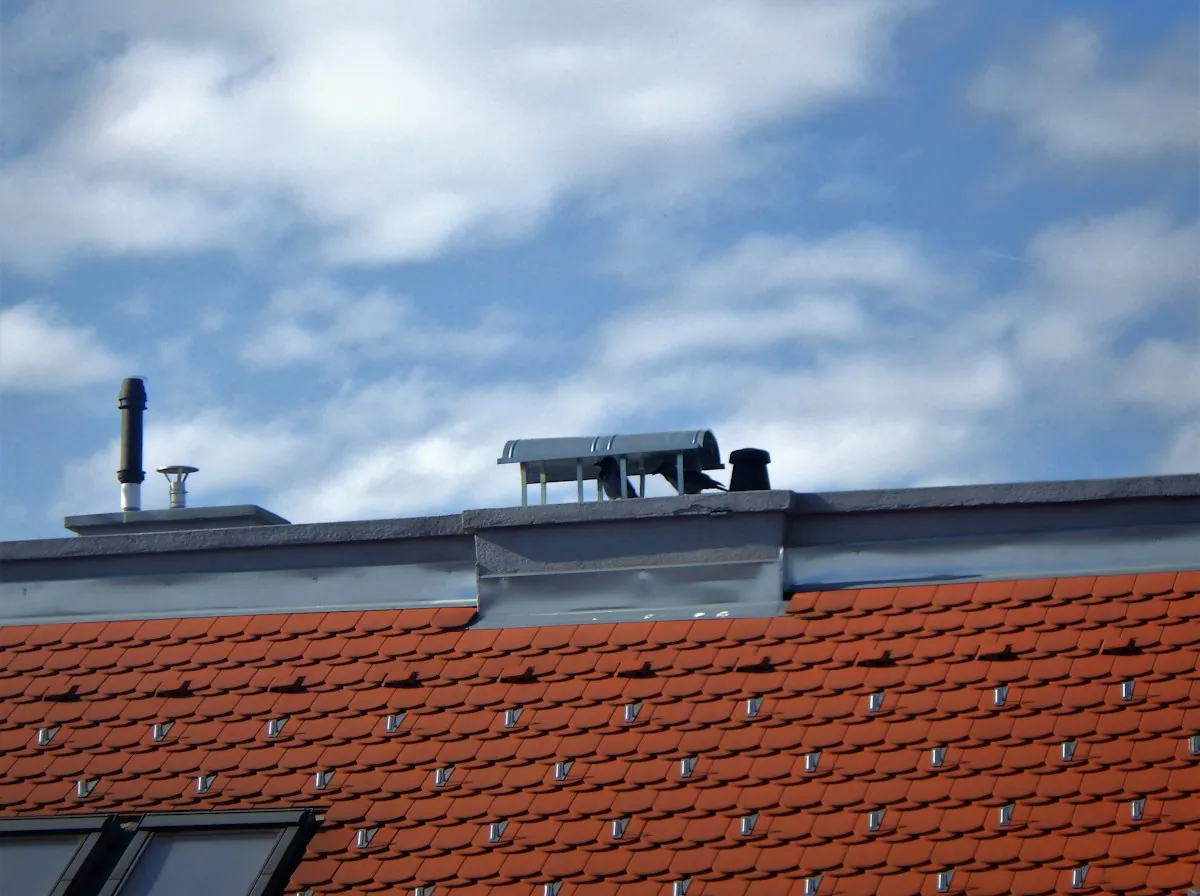
This is the edge-failure end of the range. Attached buildings have no eaves and no gutters in the usual sense: water leaves through a parapet outlet or a scupper, so repairs here are coping, upstand and outlet work. Diagnosing a Passaic roof with a suburban checklist finds nothing.
Passaic sits at one extreme of the housing range this site covers, and Totowa and Rutherford sit near the other -- within a few miles of each other.
Almost every skylight leak is a flashing leak rather than a glass or seal failure. The unit sits on a curb, the covering has to be worked around and over that curb, and on a forty-year-old installation the flashing kit was frequently never there or was improvised. Sealing around the outside of a skylight is not a repair -- it is a lid on the problem for a season.
This is the most common confusion in this corner of New Jersey, and it sends people to the wrong conclusion about price.
Each town has its own construction office, its own fee schedule and its own inspection diary. A filing at the wrong office costs about a week, which is the only part of this that should ever affect you -- and it is entirely avoidable by confirming the route first.
An attached Garfield two-family, a post-war Clifton ranch with a driveway, and a Victorian Rutherford house with four valleys and a turret are three different jobs. The same roof honestly costs different money across a boundary, because of the building and the access rather than the geography.
A repair at $350 to $1,800 against a replacement at $9,500 to $26,000 is a real decision, and so is a flashing kit instead of a new skylight, or a physical inspection instead of infrared. We name the cheaper option when it is the correct one.
A Passaic roof fails at its edges, not in its field.
Here the flat roof is the whole roof, bounded by parapets and draining through an internal outlet or a scupper.
On a flat roof with a history of leaks and no obvious cause, infrared at $400 to $600 earns its money: wet insulation under a membrane is invisible from above and it is the commonest reason a repaired roof keeps failing.
On a parapet roof maintenance is almost entirely the outlet.
Large and varied. Real eaves, real gutters, real driveways.
Narrow plots, and two roof systems on one building.
The middle of the range, and genuinely unpredictable.
Built as a set, so the street is a reliable guide.
Mature trees. Gutter capacity beats gutter material.
Driveways and side access, but hillside staging.
Victorian detail. Never price this on area alone.
What people ask about this work, answered plainly.
Yes -- expect 10 to 20 per cent off per unit when several are done together, because the crew, the access and the set-up are already paid for. If you have more than one that is nearing the end, it is worth doing them in the same visit.
Frequently, and in New Jersey the permit is typically $100 to $350. Replacing a unit like for like in an existing opening is a different proposition from enlarging the opening, which is structural. We confirm the position with the relevant construction office before booking.
Because they are describing their own process, not the law. New Jersey has a statewide Uniform Construction Code enforced locally, so the code is identical in Passaic, Clifton, Garfield, Lodi, Elmwood Park, Hawthorne, Totowa and Rutherford. What each town has of its own is a construction office, a fee schedule and an inspection diary.
Most New Jersey repairs run $350 to $1,800, with minor work from $150 to $600. A full replacement is $9,500 to $26,000 and most 2,000 square foot houses land at $12,000 to $18,000. Gutters are $8 to $16 per linear foot and a skylight replacement $500 to $1,500.
It depends on the building. Replacing a roof covering on a DETACHED one- or two-family dwelling is ordinary maintenance under N.J.A.C. 5:23-2.7 -- no permit, no inspection. An attached house, three or more units, or anything structural is permitted work. We confirm which office and what it needs before the work is booked.
The correct construction office confirmed before anything is booked. New Jersey figures, stated per lane rather than as one number.